Over the past half century, Ho Chi Minh City University of Law (ULAW) has journeyed alongside the nation’s process of reconstruction, reform, and integration. From its earliest days as a post-reunification training institution for judicial officers to its present role as one of Viet Nam’s leading centers for legal education, the University’s history is inseparable from the development of the country’s legal system and the strengthening of the rule of law.
For fifty years, generations of faculty members, students, and alumni have shared a common commitment: to cultivate legal knowledge, professional ethics, and a deep sense of public responsibility. Through periods of hardship and transformation alike, ULAW has remained steadfast in its mission to train legal professionals capable of serving society and contributing meaningfully to the building of the Socialist Rule-of-Law State of Viet Nam.
Early Foundations: Responding to a National Need (1976–1987)
In the years following national reunification, Southern Viet Nam faced an urgent need for qualified judicial and legal personnel. Against this backdrop, the Government established the Central Judicial Cadre Training School in Ho Chi Minh City in May 1975, under the authority of the Supreme People’s Court, with the primary task of training judicial officers—particularly judges—for southern provinces and cities. The School officially began its operations in 1976, marking the first systematic effort to provide structured legal training in the South after reunification.

The Central Judicial Cadre Training School in Ho Chi Minh City (also known as the Southern Judicial Cadre Training School) during its early years of operation
Operating under modest conditions, with limited facilities and a small academic staff, the School nevertheless fulfilled its mission with dedication. Through short-term and intermediate-level programs, it supplied hundreds of legal officers to local judicial institutions, contributing to the stabilization of the post-war judicial system. In 1982, following the re-establishment of the Ministry of Justice, the School was placed under ministerial management and renamed the Ho Chi Minh City Secondary School of Law, continuing its important role in standardizing legal knowledge for grassroots judicial personnel.
A particularly meaningful milestone was reached during the period 1983–1988, when the School collaborated with Hanoi Law University to organize undergraduate law programs in Ho Chi Minh City. For the first time, students in Southern Viet Nam were able to pursue Bachelor of Laws education without leaving their region, laying the groundwork for the long-term development of university-level legal education in the South.
Growth and Affirmation: Toward University-Level Education (1987–1995)
As Viet Nam embarked on the Đổi Mới reforms in the late 1980s, the demand for university-trained legal professionals increased rapidly. Responding to this need, the Council of Ministers issued Decision No. 357-CT on 25 December 1987, establishing the Ho Chi Minh City Branch of the University of Law under the Ministry of Justice. This decision marked a significant turning point, elevating the institution from intermediate-level training to formal undergraduate legal education.

The establishment of the Ho Chi Minh City Branch of the University of Law marked a major milestone, elevating the institution from an intermediate-level school to a branch of a law university responsible for full-time Bachelor of Laws education for the southern provinces

Students of the Ho Chi Minh City Branch of the University of Law
During this period of expansion, the Branch focused on building its academic staff, developing structured curricula, and compiling standardized teaching materials. In 1993, it was renamed the Ho Chi Minh City Branch of the University of Law, reflecting a unified approach to legal education within the national higher education system. By the mid-1990s, the institution had emerged as a key provider of legal education in Southern Viet Nam, standing alongside Hanoi Law University in fulfilling the national mission of training legal professionals.

In 1993, the Ho Chi Minh City Branch of the University of Legal Studies was officially renamed the Ho Chi Minh City Branch of the University of Law
Transformation and Integration: A New Institutional Identity (1995–2000)
The year 1996 marked a historic milestone. Pursuant to a decision of the Ministry of Education and Training, Ho Chi Minh City University of Law was officially established through the merger of the Ho Chi Minh City Branch of the University of Law and the Faculty of Law of Ho Chi Minh City University of General Sciences, becoming a member institution of Vietnam National University, Ho Chi Minh City (VNU-HCM).
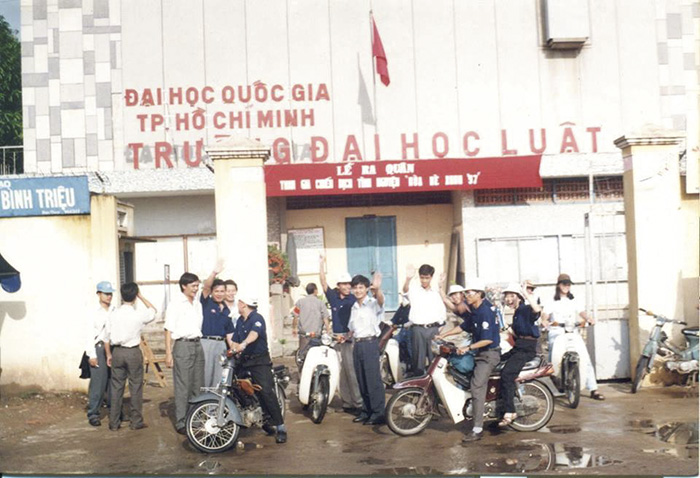
The main gate of the Binh Trieu Campus in 1997
This merger brought together two complementary traditions: the professional orientation of legal training under the Ministry of Justice and the strong academic foundations of a comprehensive university environment. During its affiliation with VNU-HCM from 1996 to 2000, the University benefited from interdisciplinary interaction, expanded research activities, and gradual improvements in facilities and academic governance. These years provided valuable experience and a solid foundation for the University’s future development.
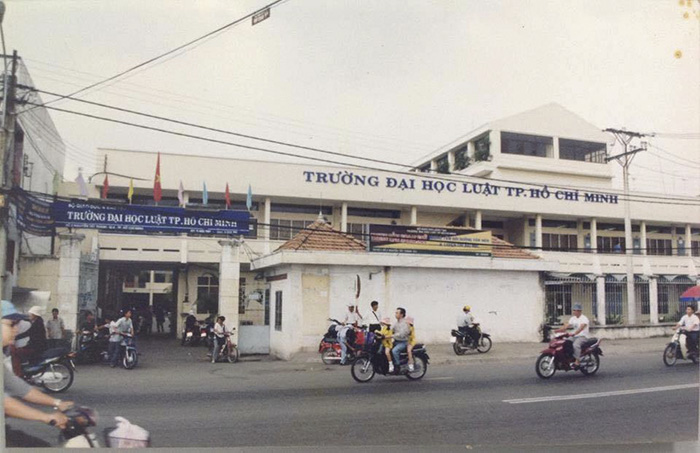
The Nguyen Tat Thanh Campus prior to its reconstruction
On 10 October 2000, a decision by the Prime Minister separated the University from Vietnam National University, Ho Chi Minh City, establishing it as an independent public university under the direct management of the Ministry of Education and Training. This transition opened a new chapter, enabling the University to pursue its development with greater autonomy and strategic vision.
Maturity and Recognition: Advancing with Confidence (2000–Present)
Since becoming an independent institution, Ho Chi Minh City University of Law has continued to grow in scale, quality, and academic reputation. The University has been designated as one of Viet Nam’s two key national institutions for legal education. In 2013, it was officially recognized by the Government as a key institution for training legal professionals, and in 2017, it was selected to participate in pilot reforms aimed at enhancing university autonomy.
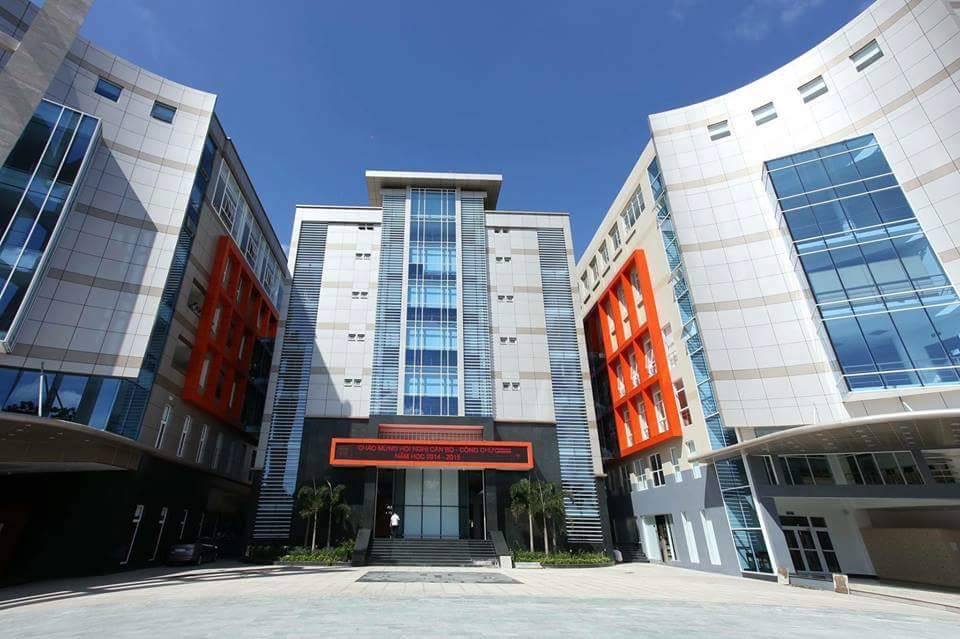
The Binh Trieu Campus, with a total area of approximately 12,000 square meters, comprising three academic buildings and a modern library system
Today, ULAW offers a diverse range of programs at undergraduate, master’s, and doctoral levels, covering both traditional legal disciplines and interdisciplinary fields such as International Trade Law, Law and Business Administration, Legal English, International Business, and Finance and Banking. Its academic community comprises nearly 500 officials and employees, including more than 330 lecturers—among them many professors, associate professors, and doctoral degree holders—who form the backbone of the University’s teaching and research excellence.
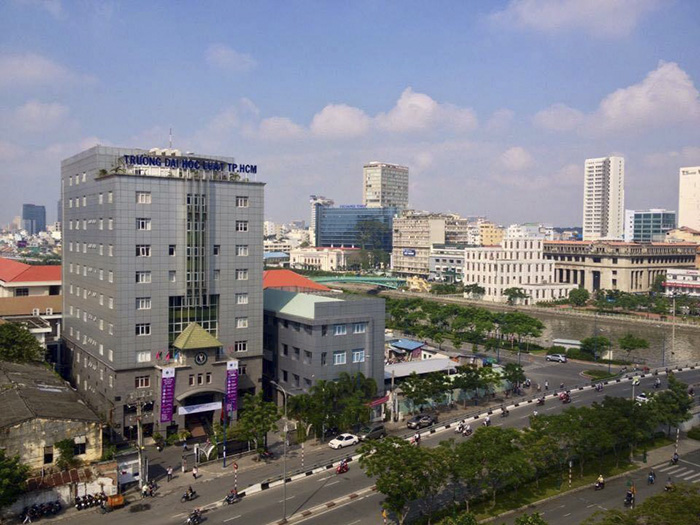
The Nguyen Tat Thanh Campus at present, featuring a modern 11-storey building with a total floor area of 8,800 square meters and a state-of-the-art library of more than 2,400 square meters
Graduate outcomes have consistently been well regarded by society, with high employment rates and strong employer satisfaction. At the same time, the University has invested significantly in modern facilities, operating three campuses equipped with contemporary learning spaces, a comprehensive digital library system, and robust information technology infrastructure supporting digital transformation.

ULAW students attending class at the Long Phuoc Campus
ULAW’s commitment to quality assurance, research, and international engagement has yielded notable results. The University has established partnerships with numerous law schools worldwide and implemented international joint programs, most notably the dual-degree program with the University of Arizona (United States). These initiatives have broadened academic horizons and enhanced the global competencies of students and faculty alike.
In recognition of its enduring contributions, Ho Chi Minh City University of Law has been honored with many prestigious awards from the Party and the State, including the First-Class Labor Order in 2016, marking a proud milestone in its fifty-year journey of service to legal education.
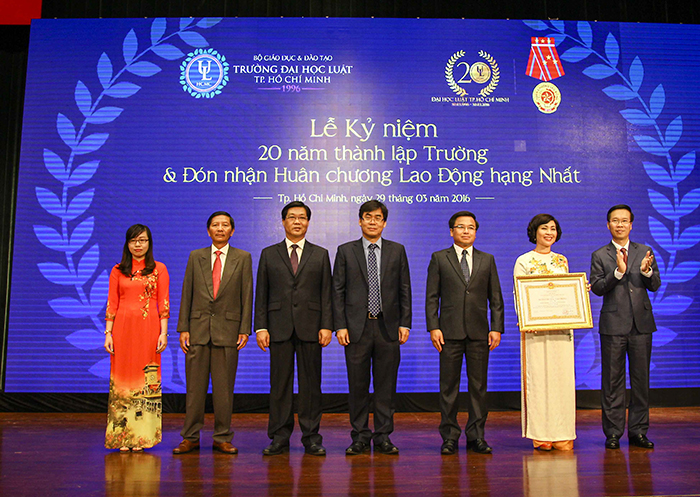
Ho Chi Minh City University of Law was honored with the First-Class Labor Order in 2016
Honoring the Past, Shaping the Future
As it approaches its 50th anniversary in 2026, Ho Chi Minh City University of Law views this milestone not only as an occasion to reflect on a proud legacy but also as an opportunity to chart a forward-looking path. Building on its strong traditions, the University is committed to developing a digital university model, promoting interdisciplinary education, and reaffirming its role as a national key institution for legal training in response to the demands of judicial reform and international integration.
A rich program of commemorative activities—ranging from academic conferences and cultural and sporting events to alumni engagement and community service initiatives—will celebrate the shared memories and collective achievements of generations of faculty members, students, and alumni. With confidence grounded in experience and a clear vision for the future, Ho Chi Minh City University of Law continues its journey, steadfast in its mission to nurture legal professionals who serve society and the nation.
-----
Credits
Content: Hồng Giang
Photos: ULAW Archive
Department of Communications and Enterprise Relation
➖ ➖ ➖ ➖ ➖ ➖ ➖ ➖ ➖ ➖
📝TRƯỜNG ĐẠI HỌC LUẬT THÀNH PHỐ HỒ CHÍ MINH (ULAW)
☎Hotline: (028) 39400.989 – 1900.5555.14 – Zalo: 0879.555.514
🔗Website: https://hcmulaw.edu.vn/
🔗Chuyên trang 50 năm: https://50years.hcmulaw.edu.vn/
📲Fanpage: https://www.facebook.com/hcmulaw/
Youtbe: https://www.youtube.com/@ulawhcm
📲 TikTok: https://www.tiktok.com/@ulawtv
#50NamTruyenThong #30NamMangTenTruong #VungBuocVuonTam #ULAW50 #KỷNiệm50Năm #TrườngĐạiHọcLuậtTPHCM #ULAW #VữngTruyềnThốngSángTươngLai #ULAW #ĐạiHọcLuậtThànhphốHồChíMinh